

Chi Gong and Tai Chi: The Mathematical Science Behind Frequency Medicine
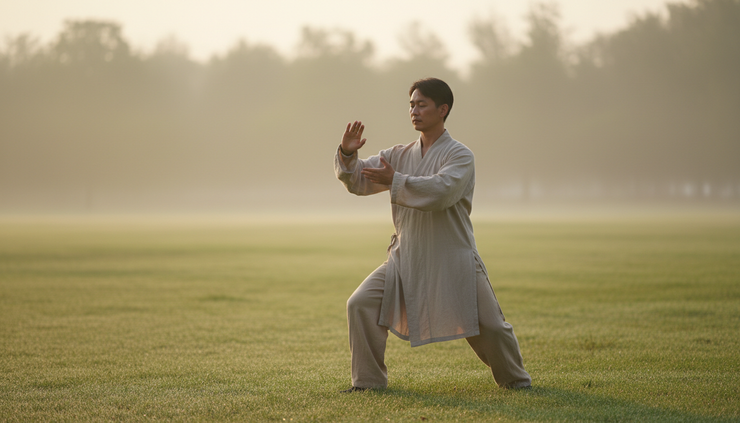
A slow Tai Chi form can look like nothing is happening, until the body softens, the breath settles, and a person who felt scattered suddenly feels steady. Chi Gong, often written as Qigong, can feel even stranger from the outside. Small movements, quiet standing, gentle breathing, and focused attention seem too simple to create real change.
That is why people often reach for the word “magic.”
The better word is pattern. Chi Gong, Tai Chi, and many forms of frequency medicine work with rhythms the body already uses: breath, heartbeat, nerve firing, muscle tone, pressure waves, electrical signaling, and attention. Those rhythms can be described with mathematics. They can also be felt directly.
This article is informational only and should not replace medical care. Frequency-based tools and movement practices may support well-being, but they should not be used as a substitute for diagnosis or treatment from a qualified clinician.
Why slow movement can create powerful effects
The body is not a collection of separate parts. It is a living system that constantly measures, adjusts, and responds.
Every second, the body tracks:
Pressure changes in the blood vessels
Stretch in the lungs and muscles
Position of the joints
Temperature and pain signals
Balance signals from the inner ear
Electrical activity in the heart and brain
Chemical changes in the blood
Chi Gong and Tai Chi use slow movement to give the nervous system clear information. The pace matters. When movement slows down, the brain can sense more detail. The joints, fascia, muscles, and breath start to coordinate.
That coordination is not mystical. It is feedback control.
A thermostat gives a simple example. It measures temperature, compares it to a set point, then turns heat on or off. The body does something far more complex. It measures internal states and adjusts muscle tension, heart rate, breathing, hormone release, digestion, and alertness.
Slow movement improves the quality of that feedback. Instead of forcing the body into change, Chi Gong and Tai Chi invite the body to notice itself with less noise.
This is one reason these arts are often used for balance, relaxation, mobility, stress reduction, and body awareness. Research on Tai Chi and Qigong suggests benefits in some areas, especially when practiced consistently, but effects vary by person, condition, and practice quality.
The mathematics of rhythm begins with waves
Frequency simply means how often something repeats over time. In physics and mathematics, frequency is usually measured in hertz, or cycles per second.
A wave has a few basic features:
Wave feature | What it means in the body |
Frequency | How often a rhythm repeats, such as breaths per minute |
Amplitude | The strength or size of the signal, such as depth of breath |
Phase | How rhythms line up, such as breath and movement |
Coherence | How smoothly parts of a system coordinate |
Resonance | When one rhythm supports or amplifies another |
Breathing gives the clearest example.
A person breathing 12 times per minute is breathing at 0.2 Hz, because 12 breaths per minute equals 12 cycles in 60 seconds. A person breathing 6 times per minute is breathing at 0.1 Hz.
That number matters because slow breathing near that range can influence heart rate variability, or HRV. HRV describes small changes in time between heartbeats. A healthy body does not beat like a rigid machine. It changes from beat to beat as the nervous system adapts.
When breathing slows and becomes smoother, the heart often begins to speed up slightly on the inhale and slow down slightly on the exhale. This pattern is called respiratory sinus arrhythmia. It is normal. It shows the heart and breath talking to each other.
Chi Gong and Tai Chi often guide the practitioner toward this kind of rhythmic coordination without requiring a math lesson. The math is there anyway.
Why it can feel like frequency medicine
Frequency medicine is a broad term. Some people use it loosely for any healing method involving vibration, sound, light, electricity, magnets, or subtle energy. A more careful definition is this:
Frequency medicine uses rhythmic signals to influence biological systems.
Some examples are well established in conventional care. Others remain experimental or have weaker evidence.
Method | Frequency-based element | Evidence status in general terms |
TENS units | Electrical pulses for pain modulation | Commonly used, mixed but practical evidence |
Pacemakers | Electrical timing for the heart | Established medical technology |
Light therapy | Specific wavelengths of light | Used for certain conditions |
Sound and music therapy | Rhythm, tone, and vibration | Supportive evidence in selected settings |
Pulsed electromagnetic field devices | Time-varying magnetic fields | Evidence varies by device and use |
Chi Gong and Tai Chi | Breath, movement, attention, body rhythm | Research suggests potential benefits for balance, stress, and function |
The key point is that “frequency” does not make something automatically scientific. A frequency can be measured, but the effect still needs proof. Dose, timing, intensity, tissue type, and individual response all matter.
A violin string and a bridge can both vibrate, but the same vibration will not affect them the same way. The body is even more complex.

The quantum comparison needs care
The word “quantum” gets used in spiritual and wellness spaces because it sounds mysterious. Real quantum physics is not a synonym for anything invisible or powerful. It describes how matter and energy behave at very small scales, such as atoms and subatomic particles.
There are real quantum effects in nature. Photosynthesis, molecular bonding, and some biological chemistry involve quantum mechanics because chemistry itself depends on quantum behavior. That does not mean every healing experience is a direct quantum event in the popular sense.
A better comparison is mathematical, not magical.
Quantum physics teaches that reality at small scales is described through probability, fields, energy states, and measurement. Chi Gong and Tai Chi work at the human scale through posture, rhythm, breath, sensory feedback, and attention. They are not the same thing, but they share a useful idea: small changes in state can affect the whole system.
For example, a slight change in breath can shift heart rhythm. A slight drop in shoulder tension can change neck position, jaw tone, and breathing effort. A slight change in attention can alter how the brain predicts threat or safety.
This is where the “quantum” comparison becomes meaningful as metaphor. The body is a field of relationships. Change one variable, and other variables respond.
That is not proof of quantum healing. It is a systems view of the body, and it fits what practitioners often observe.
Resonance explains why small inputs can feel large
Resonance happens when a system responds strongly to a frequency that fits it.
A playground swing is the classic example. A small push at the right time sends the swing higher. A bigger push at the wrong time does less.
The body also has resonant patterns. Breath, circulation, muscle tone, balance, and attention all have timing. Chi Gong and Tai Chi use gentle inputs at the right rhythm:
Weight shifts repeat slowly and predictably
The breath lengthens without strain
The eyes soften and stabilize attention
The spine alternates between length and release
The hands move in smooth arcs
The feet receive pressure and send information back upward
This creates a loop. Movement changes breathing. Breathing changes the nervous system. The nervous system changes muscle tone. Muscle tone changes movement. The loop can either tighten into stress or soften into regulation.
A skilled practice changes the loop.
This is one reason Chi Gong and Tai Chi may look too gentle to matter. The goal is not maximum force. The goal is the right signal, repeated with enough consistency for the body to reorganize.
Coherence is the bridge between ancient language and modern science
Traditional Chinese medicine uses words such as qi, meridians, yin, yang, and dantian. These terms come from a different model of the body than Western anatomy. They describe lived experience, function, and relationship rather than isolated parts.
Modern science uses terms such as nervous system regulation, proprioception, interoception, fascial continuity, autonomic balance, and biomechanical efficiency.
The languages differ, but they may point to overlapping experiences.
When a Chi Gong teacher says, “Let the qi sink,” a modern interpretation might include:
Lowering the center of gravity
Relaxing unnecessary chest tension
Engaging diaphragmatic breathing
Increasing foot pressure awareness
Reducing sympathetic arousal
Improving balance through sensory feedback
When a Tai Chi teacher says, “Move from the center,” a modern interpretation might include better pelvic control, spinal organization, and coordinated force transfer through the body.
The ancient phrase is not a lab measurement. The modern phrase is not the full lived experience. Both can be useful when used honestly.

The body is electrical, mechanical, and chemical at once
Frequency medicine can sound strange until we remember that the body already runs on signals.
The heart produces measurable electrical patterns. The brain produces changing electrical activity. Nerves communicate through electrical impulses and chemical messengers. Muscles contract through electrical activation and molecular mechanics. Cells respond to mechanical pressure, light, temperature, and chemical gradients.
The body is not only chemical. It is also electrical and mechanical.
This matters because many wellness debates get stuck in false choices. One side says everything is spirit. Another side says everything is chemistry. Human biology is more layered than that.
A Tai Chi movement has mechanical effects. It loads bones and joints. It stretches tissues. It trains balance. It also affects breathing. Breathing affects carbon dioxide levels, blood pH within normal ranges, heart rhythm, and nervous system tone. Attention changes brain activity and perception of effort.
One practice can affect several systems because those systems are connected.
The math behind this is complex, but the principle is simple. Living systems are nonlinear. In a nonlinear system, input and output are not always equal. A small input can produce a large shift when the system is ready for it. A large input can do little when the system resists it.
That is why one quiet session can sometimes feel powerful, while another day feels ordinary.
Why it looks like magic
Chi Gong and Tai Chi can look magical for four main reasons.
The work is internal.
A viewer sees the arm move but not the breath, pressure shifts, attention, or release of guarding.
The effects are delayed.
A person may feel little during practice, then notice better sleep, looser movement, or calmer mood later.
The signals are subtle.
The nervous system responds to small changes. Tiny shifts in pace, posture, and breath can matter.
The language is poetic.
Words like energy, flow, and qi can sound supernatural. Often they describe sensations that are real but hard to measure in ordinary conversation.
Magic is the feeling of seeing an effect without understanding the mechanism. Once the mechanism becomes clearer, the wonder does not disappear. It becomes more grounded.
A rainbow is not less beautiful because optics can explain it.
Where the claims should stay honest
The strongest way to respect Chi Gong, Tai Chi, and frequency medicine is to avoid exaggeration.
These practices are not cure-alls. They do not replace emergency care, medication when needed, surgery when appropriate, or mental health treatment. Some frequency devices are well studied for specific purposes. Others are marketed with claims that go far beyond the evidence.
A grounded view sounds like this:
Chi Gong and Tai Chi can support regulation, balance, mobility, and body awareness.
Breath and movement rhythms can influence measurable body systems.
Frequency-based therapies vary widely in quality and evidence.
Quantum physics should not be used as a decoration for claims that have not been tested.
Personal experience matters, but it is not the same as universal proof.
This honest framing protects the practice. It also makes the real science more impressive.
How to practice with a frequency mindset
A frequency mindset does not require special equipment. It means paying attention to timing, rhythm, and response.
Try a simple practice for three to five minutes.
Stand or sit with an easy spine.
Let the shoulders drop without forcing them down.
Breathe in through the nose if comfortable.
Exhale a little longer than you inhale.
Shift weight slowly from one foot to the other, or imagine the shift if sitting.
Move the hands gently upward on the inhale and downward on the exhale.
Notice whether the breath, hands, and weight can move as one rhythm.
Do not chase a special feeling. Track what changes.
The useful questions are plain:
Does the breathing become smoother?
Does the jaw soften?
Do the feet feel clearer?
Does the mind become less jumpy?
Does the body feel warmer, steadier, or more settled?
These are not proof of a miracle. They are signs that the system is responding.

The real wonder is that the body can reorganize
Chi Gong and Tai Chi invite the body into coherent rhythm. Frequency medicine, at its best, studies how rhythmic signals interact with living tissue. Mathematics gives us a way to describe these patterns through waves, timing, resonance, feedback, and nonlinear change.
The mystery is not that these things work like fantasy. The mystery is that the body is sensitive, intelligent, and constantly adjusting.
When practice looks like magic, it may be because the visible movement is only the surface. Beneath it, breath, nerves, muscles, fascia, attention, and emotion are shifting together. That is the deeper meaning of Chi Gong and Tai Chi: The Mathematical Science Behind Frequency Medicine.
The next step is simple: practice slowly enough to feel the pattern. The numbers explain part of it. The body understands the rest.


Comments